Photo courtesy of the City of Santa Barbara, Parks and Recreation.
Path Origins
The trail through the Douglas Family Preserve winds across grasslands and eucalyptus groves. Ocean air carries salt and sage. Along the bluffs, waves collapse against the cliffs. Dogs chase each other through the fields. Now and then, a hang glider floats like a bright kite above the water. At sunset, the preserve glows. The Channel Islands shimmer across the horizon.
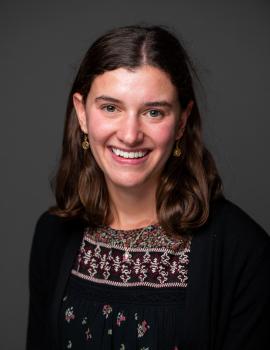
It was this walk that led Bella Pucker to choose the University of California, Santa Barbara.
Bella grew up in Newton, a residential suburban area outside Boston. “I don’t feel particularly connected to that area,” she admits. “But it was a perfectly fine, good place to grow up.” What she did love was New England’s variety of landscapes. Mountains, forests, and coastlines sat within reach. Trips to her uncle’s lakehouse in New Hampshire stuck with her. The seasons left a lasting impression.
It’s “super beautiful in all the different seasons… That’s something I really do love about the East Coast. We have four discrete seasons… Fall is the most beautiful, in my opinion. So I do miss that. But also, it being 70 degrees year-round in California, that I can’t complain about,” says Bella.
But the weather wasn’t Bella’s main reason for settling down in the Sunshine State. “It kind of felt like the right time for a time-stamped adventure, so to speak… But I felt like I wanted, at some point, to not be on the East Coast. And so grad school felt like a contained time to try to live somewhere different.”
Before UCSB, Bella studied at Middlebury College in Vermont, a small liberal arts college known for its focus on the environment and international studies. After graduating, she moved to Washington, D.C., and joined Conservation International.
Conservation International is an organization that works to improve the well-being of people and the environment. Operating in over 100 countries, Conservation International is well known in the environmental sector. She began her career there as an intern after college, then advanced to a full-time role after her first year, and ultimately became the International Policy Coordinator. She worked on projects in 13 countries, helping match global biodiversity goals with national policies. This moment sparked her passion for international work.
Professional Pivot
Her time in D.C. deepened her commitment to international conservation. It also exposed a gap in her training. She excelled in writing and interdisciplinary work, but lacked quantitative skills. That realization pushed her toward graduate school. Bren offered what she needed: technical training with a focus on environmental topics and conservation.
“I think what I was lacking in my environmental science knowledge was the more quantitative, data side of things. And Bren has a very, data-focused program,” Bella explained.
Bren requires visualizing, managing, and analyzing data.
At UCSB, Bella’s master’s project centers on the Amazon and its Indigenous communities. Her team maps climate risks and the assets within Indigenous territories, including biodiversity, carbon storage, and ecosystem services. Layering those elements reveals which regions most need protection and stronger land rights. She argues that tenure security improves outcomes for both people and ecosystems.
When asked to describe her stance on her project in one sentence, she says, “Increasing the tenure security or rights of and recognition of Indigenous territories has better outcomes both for people and the climate and biodiversity.”
The transition back to school wasn’t easy. After 3 years in the workforce, Bella had to find her rhythm as a student again. Bren’s orientation dropped her into calculus and data science workshops. At times, she doubted whether Bren was the right fit, given how different it was from her comfort zone. Over time, she settled in, finding friends, building skills, and seeing how the program would push her forward.
The technical side demanded the most from her. A data science course introduced her to coding. It didn’t come naturally, but she leaned into the challenge. She now blends quantitative analysis with her strengths in writing and policy. She doesn’t plan to be a data scientist, but she can now engage with technical work with her new skills.
This balance reflects her approach to conservation. From the start, Bella has cared less about protecting single species and is more drawn to the connections between people and the environment. She believes conservation succeeds when it centers on communities, their rights, health, and future.
People Focus
Outside academics, she builds that same balance in her life. She’s a certified yoga instructor and once considered a career in medicine before choosing environmental studies. That focus on well-being remains part of her work.
Bella credits her mentors and peers with helping her stay grounded through the inevitable moments of doubt that come with working in such a complex field. She remembers female supervisors who modeled dedication without burnout, contributing to her desire to practice balance.
“I loved my supervisor at my job between undergrad and grad school. Yeah. And I feel like her commitment to what she does, but also her work/life balance was really inspirational... It’s not always about career or school or having the most accomplishments.”
Presently, she is a teaching assistant for the “Writing Skills for Environmental Professionals” Course, where she has the power to be an inspirational figure for students. She also values her friends and the Bren community, where shared purpose makes the work feel lighter.
Through each move, from Massachusetts to Vermont, Washington, and now Santa Barbara, Bella has carried her clarity of purpose with her. To advance conservation through policy that recognizes people as part of the environment, not separate from it.
“I don’t think I’m going to solve climate change single-handedly,” she says. “But in small pockets, I hope I can make a difference.”