Image
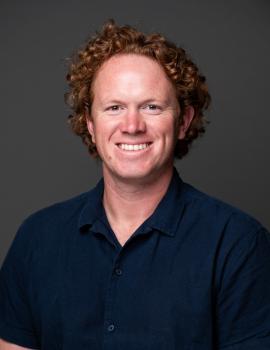
On a crisp Friday morning, O’Shea stares off at the Channel Islands from a bench on the east side of the University of California, Santa Barbara campus. At one point, O’Shea’s eyes shift to the ocean. “Dolphins!” he says while pointing to a pod of dolphins breaching just off the shore, their dorsal fins glistening as they catch the sunlight. He acknowledged them with a warm smile.
Second-year UCSB Bren Master of Environmental Science and Management (MESM) student Dan O’Shea is focused on solving the puzzle of seafood economics. His study is a unique balance between ocean preservation and extraction; an economy dealing with salt and freshwater bodies, otherwise known as the blue economy.
“I'm interested in how we allow Californian seafood to remain competitive in the international landscape, but also protect what we have. It's unfortunate because many people in the state of California don't have access to what's fresh literally here,” says Dan O’Shea.
"All I really wanted to do was be in the ocean."
Growing up in the oceanside city of San Francisco, O’Shea recalled reading his mother’s book about the Great Barrier Reef, with pages filled with pictures of invertebrates, reptiles, and all the creatures who call it their home.“I just remember being so obsessed with it,” says O’Shea with a newfound identity in marine science.
In his undergraduate years, O’Shea seized the opportunity to explore this passion at the University of California, Santa Cruz. “One of my first upper divs is an invertebrate zoology course, and I was dissecting invertebrates. I just got hooked,” says O’Shea. Clicking with marine science, O’Shea began scuba diving, where pages of that Great Barrier Reef book came alive. “From then on, it was just like, all I really wanted to do was be in the ocean,” said O’Shea.
O’Shea then took an undergraduate field quarter where he dived in the waters of the Italian island of Corsica, where he studied local octopus and abalone. Aside from research, O’Shea was mainly interested in full-time scuba.

Scuba diver navigates through a kelp forest near the California Channel Islands.
He went on to spend four subsequent summers teaching grades 5 through 12 on the California Channel Islands. On the islands, O’Shea developed a hands-on curriculum on marine biology, ecology, and oceanography.
“I was really excited because I was working with students,” O’Shea says, “actually being out with snorkels and showing them firsthand, that got me.” Moreover, he achieved dive master and scuba instructor certification after four and a half years. “What gets to me about scuba diving is that there's so much going on underwater. It's a whole different world. And it's so fun to be immersed in a place where everything is evolving. They have to deal with currents and tides. So the level of adaptation that you see in the ocean is just in constant flux because of all these changing conditions, and they just fascinate me,” says O’Shea
With a fascination for scuba diving at the center of his career, O’Shea transitioned to a wider field: the blue economy.
“The blue economy is a concept and economic initiative. It's bolstering anything that's predominantly related to the ocean as well as freshwater ecosystems. Anything surrounding the multi-use of our oceans in a way that's going to provide support and more jobs for people who are living in coastal adjacent communities.”
Beyond the economic transactions, O’Shea seeks to protect the ocean as well. The intersection between his affinity with the ocean and his duty to protect it lies in our blue economy. This includes tourism, fisheries, oil rigs, and the product most readily available on O’Shea’s mind: seafood.
“How do we engage the community to support the blue economy so we can preserve what we have along the coastline and still provide jobs for people who are living in these areas?” O’Shea ponders over this key issue.
Additionally, he expressed concerns about the “aging of the fleet” phenomenon, where the future of seafood is uncertain due to the lack of young people becoming fishermen. Once the current fleet becomes too old, who will sustain this industry?
“Inconvenience talks.”
“Infrastructure in these coastal areas is super expensive. There's a lack of space for harbor and boat storage or flash freezing facilities and cold storage that are all here to support the seafood industry in the blue economy,” says O’Shea.
O’Shea explained how the price of local seafood, like the California Spiny lobster, is so competitive in Asia that locals seldom eat it here. Instead, we’re served imported lobster from different corners of the world.
“Inconvenience talks,” stated O’Shea. It’s more convenient to sell lobster internationally at a consistent high wholesale price than to only sell domestically. Likewise, uni, or red sea urchin, has a similar demand where most of the supply is shipped to Asia rather than served right in Santa Barbara. In fact, O’Shea stated that this is some “world-renowned” uni that is being shipped out. He’s frustrated that most local seafood isn’t served locally. This is because if you were to sell local food, you’d have to constantly change your menu due to catch fluctuations. In other words: inconvenience.
World renowned uni from the Santa Barbara channel.

Ultimately, O’Shea has recognized the dilemma that international trade is necessary for fishermen to make a profit since local profits can be unstable. But he recognizes that a more local trade system, whether that be through cities throughout California, is much more sustainable and will create a unique taste palette to the state.
Across the world, eateries are trying to capture the palettes of everyone. But what if we let local flavors shine a bit harder? In turn, this promotes tourism since there is a better reason to visit: food.
It’s complicated because O’Shea’s utopia would have trade kept to a minimum and that local sustainable food would be the main item on the menu. O’shea points out, however, that the more sustainable thing to do is to let those who best produce one thing continue doing so. He does not want to exhaust resource reserves such as a salmon population in Norway.
O’Shea recognizes that there needs to be a balance between all these factors: the locally caught food, a spark of interest in joining the blue economy, sustainably sourced international trade, and hefty international demand.
His holistic approach has helped him fall in love with the field and continue to tackle different aspects of the local seafood industry. He has seen the creatures firsthand, has educated children about the ocean’s complexities, and now he seeks to educate at a local level to bring awareness of the blue economy and the future improvements to come.