The City of Santa Barbara has been at the forefront of advancing climate policy and taking effective climate actions. To help the City achieve community-wide climate targets with inclusive community engagement, the team created climate outreach strategies, including designing a series of themed workshops and a climate ambassador program.
This project team designed a transferable decision support tool to help Groundwater Sustainability Agencies (GSAs) in California’s Central Valley to identify the most suitable sites for MAR, giving them the information they need to plan for a more reliable and resilient water supply that can provide the most benefit for local communities and ecosystems.
This project worked with Apeel Sciences, a small biotechnology startup interested in sourcing food waste as an input to their product, to evaluate the environmental impacts of sourcing waste using two different Life Cycle Assessment methodologies, economic allocation and substitution.
Beach closures to protect the Western Snowy Plover in Lompoc, CA have generated negative community sentiments towards the threatened bird. But a new 2019 policy allows public access to Surf Beach. This project aims to understand community concerns surrounding beach access, and to foster environmental stewardship among Lompoc residents.
This project assessed the effectiveness of regenerative organic practices to store soil carbon, modeled greenhouse gas emissions and evaluated the effect of different regenerative organic practices on total GHG emissions, and developed recommendations for Patagonia on which practices have the largest impact on carbon sequestration in the soil.
The ‘Greenhouse Sass’ podcast breaks down current environmental headlines, in an accessible and conversational way. With quirky humor, topical environmental issues are explained by reviewing relevant scientific studies. Three 20-minute episodes will be discussed, covering Microplastic Generation, Coral Bleaching, and the future of Renewable Energy.
This project examined if the Environmental Defense Fund's Framework for Integrated Stock and Habitat Evaluation (FISHEF) would continue to provide sound guidance to data-limited fishery managers given the influences of global climate change on fish.
This project assessed the relationships between air pollution particulate matter 2.5 (PM2.5) and diabetes prevalence throughout the state of California using a cross sectional and panel data approach for the Sansum Diabetes Research Institute.
Small-Scale Big Deal is a multimedia project to raise awareness of small-scale fisheries. Using short films and social media, the main objective is to illustrate who small scale fishers are, what they do, why they do it, and how consumer demand impacts their lives. @smallscaleBIGDEAL
Through evaluating the benefit of adding rain capturing technology to Austin, TX, this project aimed to create a versatile evaluation framework for water management projects in other municipalities.
This project analyzed the willingness of small-scale fisheries to participate in a vessel tracking program that is incentive-compatible to their preferences. The team conducted a dual response choice experiment to evaluate fisheries' preference data from surveys conducted in Indonesia and Mexico, then utilized a contingent valuation to gauge both fishers’ willingness to pay for a tracking program and the effects of fishers’ characteristics on their willingness to pay.
In conjunction with the Joint Institute for Wood Products Innovation (through the California Board of Forestry and Fire Protection), the project team aims to assess how California’s forests may support statewide carbon neutrality. The project focuses on determining the costs and carbon consequences of a host of forest management treatments across all forests in California, and how these treatments can contribute to the State’s climate goals.
This study explored the spatial feasibility of mariculture development and create an interactive web-based tool to predict potential locations, yields, and profitability for offshore mariculture of cobia (Rachycentron canadum) in Brazil’s Exclusive Economic Zone (EEZ).
This project developed a model using the Environmental Protection Agency’s Storm Water Management Model 5.1 to facilitate identification of "hotspot" areas that contribute higher stormwater pollution relative to surrounding areas in the Maunalua Bay Region, O'ahu, Hawai'i.
Arundo donax, or giant reed, is an invasive plant species that thrives around rivers and streams. Bad Grass creates consumer products thus promoting demand for Arundo biomass. By introducing a line of cannabis pipes that are strategically positioned between joints and pipes, we can attract customers interested in smoking out of disposable pipes.
Powered by Moxie is an Eco-Entrepreneurship Project that analyzes the environmental impacts of different types of grocery and snack packaging and offers a solution to reduce packaging waste by using reusable packaging. Powered by Moxie delivers farmer’s market produce and snacks to corporate offices as a supplemental employee benefit program.
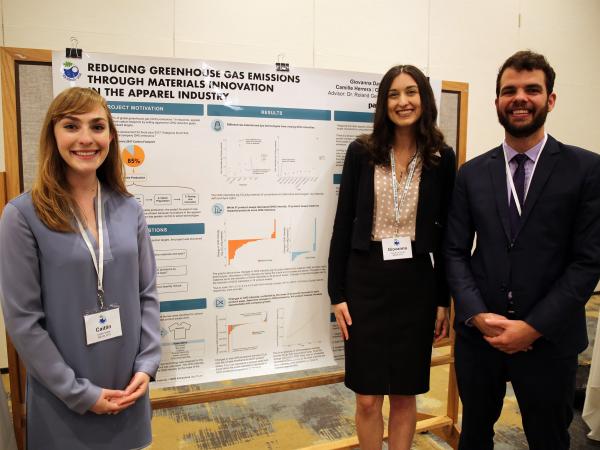
By modeling various product changes out to the year 2035 with company growth, this team identified the material and dye applications with the largest GHG savings for apparel company Patagonia. From this, they sought to develop realistic product change recommendations to decrease the overall environmental impact of Patagonia’s products.
This project aimed to identify synergies and tradeoffs between agricultural practices, ecosystem health, and human wellbeing in Rwanda. Their approach was to examine Vital Sign’s integrated data across a variety of indicators. This analysis was then used to inform agricultural development decisions.
This research group project was commissioned by The Nature Conservancy (TNC) to conduct a watershed analysis of the Carson and Walker river basins of Douglas County, Nevada. They developed a conceptual model of the local watershed, evaluated ecosystem services and the impacts of climate change, as well as performed a market feasibility study to determine if a water fund mechanism would be possible in the region.
This project provided a unique opportunity to use history to inform conservation planning. The property has a long history of human land use, with controlled fires set by the Chumash and centuries of ranching under Spanish land grants. Due to the lasting influence of human disturbance on ecosystem structure and function, a comprehensive understanding of land use history is essential to an effective conservation plan.